5 Best Towns in Devon to Retire on a Budget
Devon often enters retirement conversations through dreamy images of coves, cream teas, and expensive harbours, yet the county is far more varied than that postcard version suggests. For retirees watching their pension income, the better question is not which place looks grandest, but which town keeps daily life affordable and easy. Good value comes from the mix of housing, shops, buses or rail, healthcare, and a sense of local community. The five towns below stand out because they offer different ways to enjoy Devon without paying premium coastal prices.
Outline
– What makes a Devon town retirement-friendly on a modest budget
– Why Tiverton, Honiton, Bideford, Newton Abbot, and Great Torrington make sense
– How housing, transport, healthcare, and lifestyle compare in each place
– Which type of retiree is most likely to feel comfortable in each town
1. Tiverton: Solid Value in the Heart of Devon
Tiverton rarely tops glossy retirement wish lists, and that is exactly why it deserves attention. It is a practical Mid Devon market town rather than a polished coastal showpiece, which usually means better value for buyers and renters. In broad terms, homes here often cost less than properties in Exeter, Exmouth, Sidmouth, or the more celebrated estuary and seaside spots. That matters if retirement income needs to cover more than the mortgage or rent. Heating, groceries, occasional taxis, and the little repairs that ambush older homes can quickly turn a picturesque move into an expensive one.
What Tiverton offers is balance. The town has everyday infrastructure that many smaller places cannot match. You have supermarkets, pharmacies, GP services, banks, cafés, and a regular retail rhythm that makes life easier when you do not want every errand to become a half-day expedition. Tiverton also benefits from proximity to Tiverton Parkway station, which sits outside the town but gives useful rail access toward Exeter, Taunton, Bristol, and London. That is a real advantage for retirees who want to stay connected to family without paying city or premium commuter-town prices.
There is also a quieter quality of life here that grows on people. The Grand Western Canal adds greenery and gentle walking routes, and the pannier market gives Tiverton some of the texture people often fear they will lose when choosing value over glamour. It is not the sort of place that sells itself with dramatic sea views. Instead, it wins through routine comfort. On a damp Devon morning, when the practical stuff matters more than brochure photography, Tiverton starts to look very sensible.
A few key strengths stand out:
– Housing is often more attainable than in many South and East Devon hotspots.
– Day-to-day shopping is straightforward, with good local services.
– Road access to the M5 is helpful for visiting family or reaching larger hospitals.
– The town offers a mix of flats, smaller houses, and some bungalow options that suit later-life living.
The compromise is obvious: if your retirement dream absolutely depends on living beside the sea, Tiverton will feel inland and ordinary. Yet for budget-conscious retirees, ordinary can be a virtue. Compared with prettier but pricier rivals, Tiverton gives more room for the numbers to work. It suits people who want Devon as a place to live well, not merely a place to admire from the promenade.
2. Honiton: East Devon Access Without Peak Coastal Prices
Honiton occupies a sweet spot that can be very appealing in retirement. It sits in East Devon, a part of the county that many people love for its countryside, access to the Jurassic Coast, and generally gentler pace. The problem is that some of East Devon’s best-known retirement addresses, including Sidmouth and Budleigh Salterton, can be difficult on a modest budget. Honiton offers a more grounded alternative. It is not cheap in the abstract, but it is often more attainable than the polished coastal favourites nearby, while still giving you access to the same region.
The town’s transport links are a major reason it works so well. Honiton has a railway station on the line between Exeter and London Waterloo, which is useful for retirees who want a manageable town without feeling cut off. There is also road access via the A30, making trips into Exeter relatively simple. That combination matters more than people sometimes realise. A beautiful retirement town can lose its appeal quickly if every hospital appointment, family visit, or winter shopping run becomes awkward. Honiton makes those routine journeys easier than many smaller Devon settlements.
In terms of daily life, Honiton has the feel of a working market town rather than a seasonal resort. That is good news for budgeting. You are relying less on tourist-driven pricing and more on a place that serves local residents year-round. The high street is known for independent shops, antiques, and food options, but there are also the basics that support ordinary living. Healthcare access is reasonable for a town of its size, and larger services in Exeter are not far away. Housing varies, with period homes, modern estates, and retirement flats, so there is at least some choice depending on maintenance needs and mobility.
Honiton also has a softer, more lived-in charm than some towns that try too hard to impress. It can feel like a place where people still do the weekly shop, stop for a chat, and know which bus goes where. For many retirees, that social texture matters. A few comparisons help clarify its appeal:
– It is usually more affordable than the standout East Devon coastal towns.
– It offers better rail convenience than many small rural alternatives.
– It is less dramatic than living right on the coast, but often far easier to manage financially.
Its main weakness is that it does not deliver the instant romance of a seafront address. Some streets are more functional than beautiful, and traffic can be noticeable in parts of town. Even so, Honiton is an intelligent compromise. It suits retirees who want East Devon’s landscape and accessibility without stepping into the county’s most inflated property markets.
3. Bideford: North Devon Character at a More Manageable Cost
Bideford is one of the most interesting options for retirees who want a sense of place without paying the premium attached to Devon’s best-known coastal villages. Set on the River Torridge in North Devon, it has history, useful amenities, and a strong local identity. Compared with picture-perfect spots such as Instow, Appledore, or some of the surfing belt near the North Devon coast, Bideford often looks far more realistic on a retirement budget. You are still close to estuary scenery, beaches, and walking routes, but the everyday cost of getting a home can be less punishing.
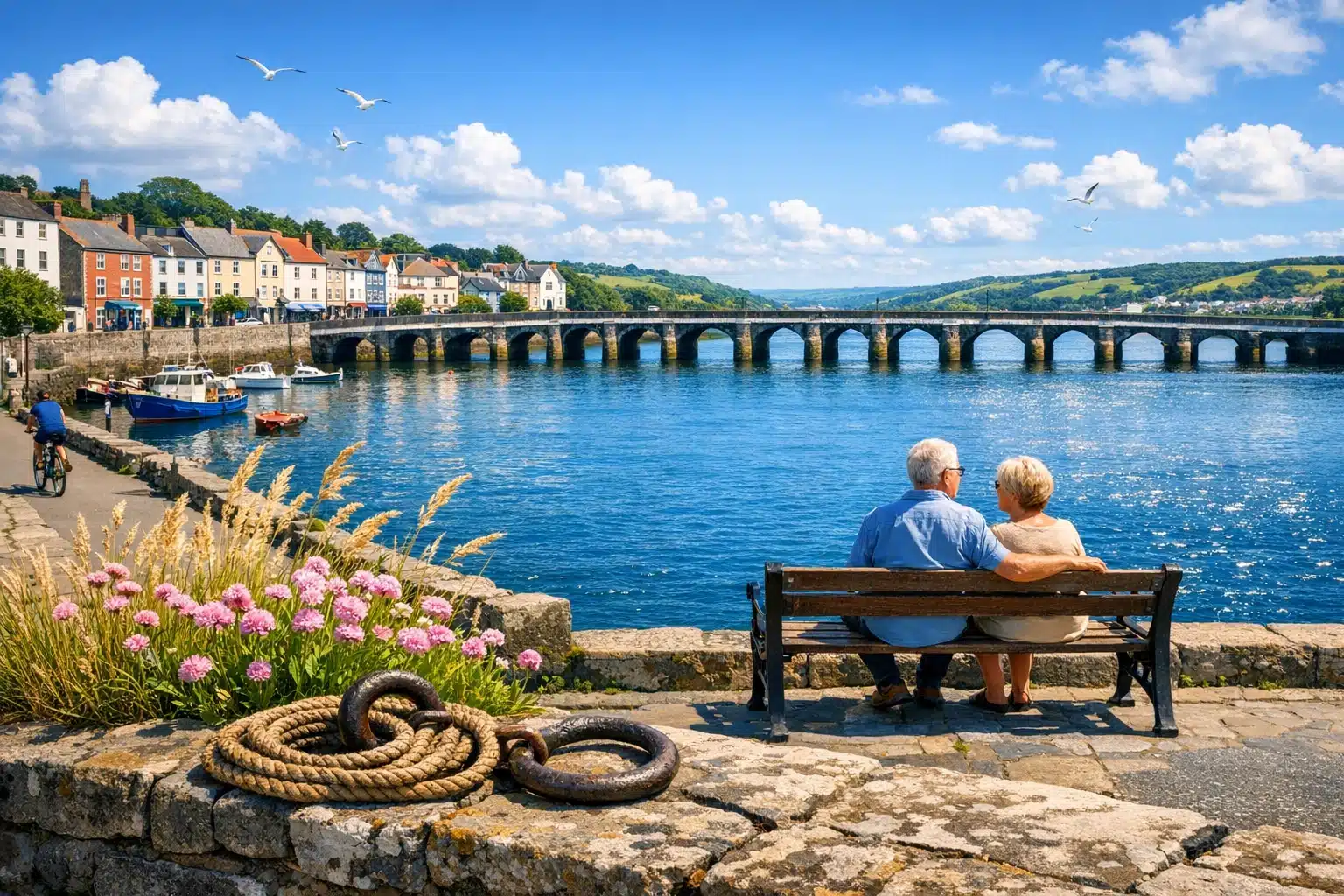
The town works best for people who value atmosphere over trendiness. Bideford is not trying to be a luxury destination. It is a former port town with a proper centre, regular shops, local services, and a pace that many retirees find comfortable. The famous white bridge, the quay, and the riverside views give it charm, while the Tarka Trail offers one of the area’s best easy-going outdoor assets for walking and cycling. On the right day, with gulls moving over the estuary and the light changing on the water, Bideford feels like a place that gives you the spirit of coastal Devon without the punishing buy-in.
From a practical point of view, the big housing advantage is variety. You can find terraced homes, flats, and some bungalows or edge-of-town developments that may compare favourably with far pricier seaside locations. Daily shopping is straightforward, and Barnstaple is close enough for additional services, including larger retail options and hospital access. That said, Bideford’s biggest drawback is transport. It does not have its own rail station, so retirees who do not drive or who expect frequent train travel may find it less convenient than Tiverton, Honiton, or Newton Abbot. Bus links exist, but they are not the same as stepping onto a train in town.
Here is where Bideford stands out:
– North Devon lifestyle without the highest coastal housing costs
– Strong sense of community and local identity
– Good access to riverside walks, nearby beaches, and scenic day trips
– Practical shopping and services for a town of its size
Bideford is best for retirees who still want character around them and can accept a weaker public transport setup. It is less polished than the county’s elite coastal addresses, but that rougher edge is part of its value. If your budget prefers substance to prestige, Bideford deserves a serious look.
4. Newton Abbot: A Practical South Devon Base That Keeps You Connected
Newton Abbot may not be the town that visitors daydream about first, but retirement planning is not a beauty contest. It is about finding a place that keeps life workable, social, and affordable enough to protect long-term savings. In South Devon, where many attractive towns carry heavy property premiums, Newton Abbot stands out as a more realistic option. It often compares favourably with places such as Totnes, Teignmouth, or parts of Torbay when pure practicality is part of the decision. If you want access to the coast and countryside without paying for a full-time holiday mood, this town deserves more respect than it usually gets.
One of Newton Abbot’s biggest strengths is transport. It is a significant rail town, with connections toward Exeter, Plymouth, Torbay, and longer routes to London. For retirees, that matters enormously. Good rail access can reduce dependence on driving, make family visits simpler, and widen your choices for hospital appointments or day trips. Road links are also useful, and Exeter is close enough to feel accessible without forcing you to pay Exeter prices. This makes Newton Abbot especially attractive to people who want Devon living but still need to stay mobile and connected.
Housing is another reason it suits a budget-minded retirement. The local market tends to include a wide spread of property types, from compact flats and retirement apartments to older terraces and suburban bungalows. That range gives buyers and renters more flexibility than in smaller, highly sought-after towns where stock is limited and pricing can be stubborn. Day-to-day amenities are solid too. Shops, supermarkets, cafés, pharmacies, and community facilities are all part of the town’s draw. Nearby healthcare options, including community services and access toward Torbay or Exeter for larger hospitals, strengthen its case.
Newton Abbot’s great advantage is that it behaves like a working town first and a lifestyle purchase second. Some retirees find that reassuring. You are less exposed to the seasonal swings that shape many resort locations, and more likely to be living among people using the town for ordinary life. A short list captures the appeal:
– Better transport links than many Devon towns in the same price conversation
– Broad housing choice, including lower-maintenance options
– Easy reach of coast, countryside, and larger urban services
– Strong everyday convenience for shopping and healthcare
The drawback is straightforward: it lacks the instant romance of smaller villages or seafront towns. Certain areas feel functional rather than picturesque. But for retirees who care about resilient budgeting, easy travel, and keeping essentials close at hand, Newton Abbot is one of the county’s smartest choices.
5. Great Torrington: Quiet Living and Lower Overheads
Great Torrington is the kind of town that often appears only after a careful search, which is usually a good sign for budget-conscious retirees. Sitting on high ground in North Devon, it does not trade on glamour in the way some better-known Devon destinations do. Instead, it offers something many retirees quietly need: a chance to lower housing costs while still living somewhere with identity, scenery, and community life. In many cases, places like Great Torrington can undercut the more famous coastal and estuary towns by a meaningful margin, and that difference can shape the entire comfort of retirement.
The town has a distinctive setting and a calm, slightly old-fashioned feel that will appeal to some readers immediately and leave others cold. That is fine; retirement choices should be honest. Great Torrington tends to suit people who no longer need a large employment hub on the doorstep and are happy with a smaller-town rhythm. Essentials are available locally, and the community side of life can be surprisingly strong for a place of its size. There are independent shops, cafés, everyday services, and local cultural assets such as The Plough Arts Centre. Nearby RHS Garden Rosemoor adds another layer of appeal, especially for retirees who want beautiful surroundings without paying to live in a famous visitor hotspot.
Financially, this is where Great Torrington becomes compelling. Housing can be more approachable than in much of South Devon and more prestigious stretches of East Devon. Buyers may find cottages, terraces, and some manageable homes that fit fixed incomes more comfortably. Still, the lower prices come with a trade-off. Transport is not as strong as in Newton Abbot or Honiton, and a car can make life much easier. For larger shopping trips, hospital services, or specialist appointments, many residents rely on nearby towns such as Bideford or Barnstaple.
That trade-off should not be ignored, but it should be weighed fairly:
– Housing may stretch retirement savings further than many better-known Devon locations.
– The setting offers greenery, quieter streets, and a slower pace.
– Community life can feel more personal than in larger towns.
– Limited rail access and reduced service depth mean planning ahead matters more.
Great Torrington is not the universal answer, yet it can be the right answer for the right retiree. If you want lower overheads, a smaller scale, and the sort of place where the week is shaped by market errands, local conversations, and fresh air rather than traffic and tourism, it has real appeal. Quiet value is still value, and in retirement that can be a powerful thing.
Conclusion for Budget-Conscious Retirees
No Devon town is perfect for every retirement plan, but each of these five offers a credible route to living well without chasing the county’s most expensive addresses. Tiverton and Newton Abbot are especially strong if transport, shopping, and routine practicality sit at the top of your list. Honiton gives you East Devon appeal with better value than the county’s smartest coastal names, while Bideford offers North Devon character at a more manageable entry point. Great Torrington may stretch a pension furthest, provided you are comfortable with a smaller-town setup and more limited transport.
If you are seriously considering a move, spend time in each place on an ordinary weekday rather than a sunny weekend. Walk to the pharmacy, test the bus route, check where the nearest GP sits, and compare the cost of maintaining the type of home you are likely to buy. In retirement, financial comfort usually comes from ordinary details rather than dramatic views. The best town is the one that lets your savings breathe while still giving you a life that feels warm, connected, and worth waking up to.


